|
In modern industrial hardness test methods applications varied, endless. But no any test methode can ccover all materials or all hardness ranges. Each test methods tried to expand its scope of application, so the major test conditions will be properly mix, combined to form a different scale.
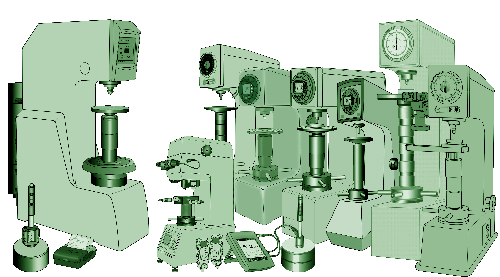
For example: Rockwell hardness test method changes due to indenter, initial test force, the total force in any one test, constitute such as HRA, HRB, HRC, HR15N, HR30T so ruler. Also the Brinell hardness test also has numerous combinations of test conditions.
To measure the same test piece with different test methode or different scale just like measure a length with different rules. You can choose one of the most appropriate method, the most appropriate scale to measure. if the measurement accuracy and the resolusion permit, the value measured on the length should be able to correspond with each other.
Similarly, hardness measured with different test scale on the same test piece should have some corresponding relation (that what is doing with the hardness conversion).
However, due to the hardness is not as simple or pure as the physical or geometry as length, it is the overall characterization of physical, chemical and mechanical properties of materials. Each test method have a different reflection for these properties, it is difficult to get 100% corresponding between the various test methods, sometime even very low degree of correlation or even no significance. This is why the hardness conversion can have sufficient accuracy only under specific conditions .
Choose a appropriate hardness test scale must consider many factors, and not as obvious. Even succumb to an industry technical traditions often.
Of course, we do not have the ability to enumerate all of the hardness scale selection criteria, but we can introduce some of the most common and the most basic.
|