
|

|
 |
Leeb Hardness Test
|
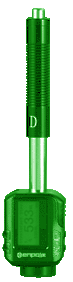
The Leeb rebound hardness test method was developed in 1975 by Leeb and Brandestini. After years of gradual improvement and standardized test practice, it becoming a new test methods.It was developed as an alternative to the unwieldy and sometimes intricate traditional hardness tester, has been more widely used. It uses a impact body with carbide ball, impact test surface at a constant speed, and generates shock rebound in the measured surface. Leeb hardness measured the hardness of the material with the ratio of Impact velocity and rebound velocity.
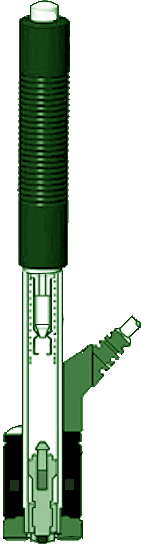
The traditional methods , e.g. according to Rockwell, Vickers and Brinell,are based on well-defined physical indentation hardness tests. Very hard indenters of defined geometries and sizes are continuously pressed into the material under a particular force. Deformation parameters, such as the indentation depth in the Rockwell method, are recorded to give measures of hardness. They are stationary, i.e. fixed workstations are set up in segregated testing areas or laboratories of plants. When using the Leeb principle, the hardness value is derived from the energy loss of a defined impact body after impacting on a sample, similarly to the Shore scleroscope. The Leeb quotient (VA,VR)is taken as measure of the energy loss by plastic deformation: the impact body rebounds faster from harder test samples than it does from softer ones, resulting in a greater value 1000. They are divided into several types depending on the probe ("impact device") and indenter ("impact body") types that vary by geometry, size, weight, material and spring force, diverse impact devices and hardness units are distinguished, e.g.: D with hardness unit HLD, C with hardness unit HLC,G with hardness unit HLG |
|
|||
| Standard |
GB/T 17394 "Metallic materials - Leeb hardness test" DIN 50156 "Metallic materials - Leeb hardness test" DGZfP Guideline "Mobile Hartepr¨¹fung" VDI/VDE Guideline 2616 Part 1 "Hardness testing of metallic materials" ASTM A956 "Standard Test Method for Leeb Hardness Testing of Steel Products" |
||||
| Tester | 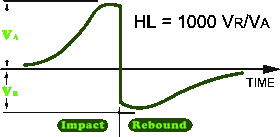 A spring projects the impact body towards the test sample and its spherical indenter strikes the object¡¯s surface at a defined speed.
 The indentation created absorbs a portion of the energy thereby reducing its speed. The softer the material the larger the indentation and the higher the energy loss. The velocities before and after the impact are measured in a non-contact mode. This is accomplished by a small permanent magnet within the impact body that induces a voltage during its passage through a coil. The voltage created is proportional to the speed impacted and rebounded. A Leeb hardness usually consists of two parts, an impact device and digital devices. Polygon have three models or series Leeb hardness tester: |
||||
| Application |
Leeb hardness tester has a small size, light weight, easy to carry, very suitable for large specimens measuring, outdoor measurement applications. |
|
|