
|

|
 |
About Leeb Hardness Test Type
|
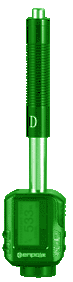
The Leeb rebound hardness test method has been introduced for about 40 years. Its easy to test and efficient to measure, deeply loved by the people. But, there are a lot of limitations in the application of its initial type. Thus, in practice, a variety of variant (type) has been produced for expanding its scope of application. Here is some Leeb hardness test types specified in the major technical standards.
As we known, a procces of impact-rebound is much more complex than the static force indentation( most of hardness test used). Any change in one factor will change the entire result of test. Use this feature, produced different types for different applications by changing some test factors. |
|||||||||||||||||||||||||||||||||||||||||||
|
The initial D-type and DC-type having the same test parameters, the only difference is: reloading mechanism is removed in DC-type, the length is shortened to fit using within a narrow space. Therefore, DC-type is not a real sense of variant. The differences of various types compared with D/DC, is shown in the following table. |
||||||||||||||||||||||||||||||||||||||||||||
|
||||||||||||||||||||||||||||||||||||||||||||

|
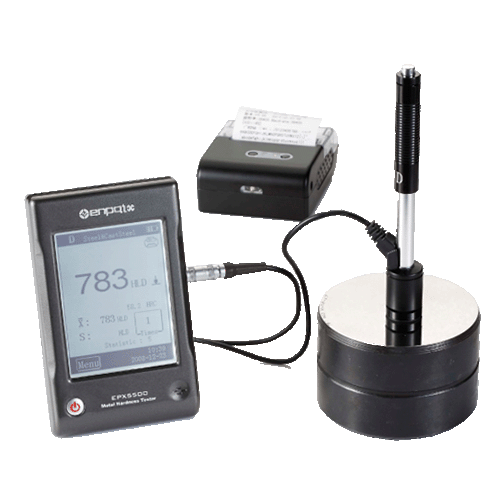
May be you have to select different hardness tester to fit your applications. Our products can fit almost all your applications. Our EPX5500 can equip all types of impact device and identify automatically. Our ETIP series and ETIPG covered all of types. |
|||||||||||||||||||||||||||||||||||||||||||
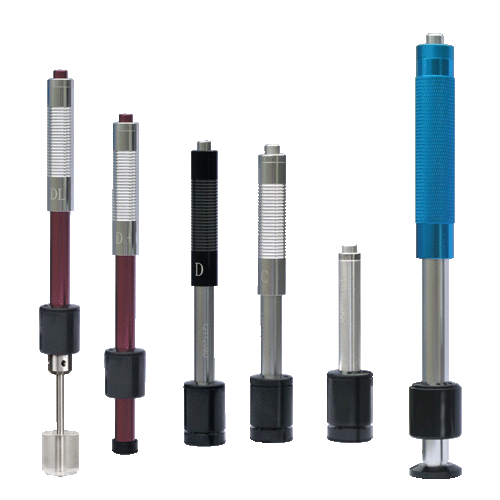 |
Type D : the basic type, it is suitable for almost all applications.Just almost. Type DC :is shortend D. So can drill into the more narrow space. Type C :have lower impact energy. It can measure the hardness more gently, and for lighter samples. Type D+15 :have a longer head and heavy impact body, for measurements in grooves and on recessed surfaces. Type DL :have the longest and finest head. For measuring of extremely confined spaces,like the end of a hole, a groove,teeth of a gear. Type E :with royal blood a little, it has a diamond tip. So it can judge the hardness of harder materials, even the tungsten carbide the other types have. Type G :a giant of Leeb family. It's longger, wider, stronger, and have a bigger tip. It's more powerful to suitable for castings, forgings and so on. |
|||||||||||||||||||||||||||||||||||||||||||
|
|